
Summary: Some leaders build a public brand that does not require constant maintenance. It does not shift when the season changes, when the audience turns critical, or when the work gets hard. This is the companion to The Psychology of Shame. Where that piece diagnosed the five shame-driven brand types, this one sets out five identity-driven archetypes, what each gives the leader and those they lead, and the examined foundation that all five share.
There is another kind of leader.
You have probably encountered them too, though they are harder to describe because they do not announce themselves. They are rarely the loudest in the room, and do not need to be. There is a quality to how they are present in a room, something settled, something that does not shift depending on who is watching or what is being asked of them. Their public presence is consistent not because it is carefully maintained, but because it does not require maintenance. It is simply who they are.
In a previous piece, I wrote about the psychology of shame and how unexamined wounds quietly become the architects of leadership brands. That article was a diagnosis. This one is different. It is an account of what becomes possible when the foundational work has been done. Not perfect leadership. Not pain-free leadership. Something more honest than either of those things: examined leadership.
These are not leaders who avoided difficulty. Most of them have carried real things. What distinguishes them is not what they have been through, but what they did with it. They asked the harder questions before they started building. And what they built bears the marks of that prior honesty.
The goal is not the absence of difficulty. It is the presence of examined identity.
What Solid Ground Actually Means in Leadership
The psychologist James Marcia, building on Erik Erikson’s work in identity development, identified four ways people arrive at a sense of self. The one that matters most here is what he called identity achievement: the state reached by someone who has actively explored who they are, gone through the difficulty and uncertainty of that exploration, and arrived at a genuine, chosen commitment. Not a default. Not a performance inherited from expectation. A foundation consciously selected after deep and honest examination. Marcia studied this in adolescents, but the posture it describes does not expire at eighteen.
Most leadership development skips this. It moves directly to skill, strategy, and visibility. It assumes the interior foundation is already in place, or that it is not the point. This is the gap that produces the shame-driven brands described in the previous piece. Leaders who build before they know what they are building from.
Marcia’s identity achievement is not a finished state. It is a posture. The leader who has achieved it is not someone who has resolved every question about themselves. They are someone who has learned to ask the honest questions, sit with the uncertainty, and build from what they find rather than from what they wish were true.
Bill George, in his research on authentic leadership, describes something similar. The leaders he and Peter Sims studied who built with sustained integrity and genuine influence were not those who had the cleanest stories. They were those who had examined their stories most thoroughly, including the parts they would have preferred to leave unexamined.
Solid ground, in this context, does not mean easy ground. It means examined ground. Ground that has been tested by honest questioning and found to hold.
The Foundation Beneath Every Identity-Driven Leader
Before setting out the five archetypes, it is worth observing what they share. Because the archetypes themselves are distinct, but the foundation beneath them is the same.
Each of these leaders has done some version of what could be called genesis work: the prior, foundational excavation that precedes any external expression. The questions it requires are not complex, but they are uncomfortable in a way that urgency-driven leadership rarely makes room for. Who am I when the performance stops? What do I actually believe, not what I have said I believe, but what do my decisions reveal? What am I building, and is it mine? These are the same questions I have argued matter more than tooling in a related piece on why AI anxiety is really an identity problem, where identity comes before expression.
The leaders who have genuinely answered those questions build differently, not through greater talent or discipline, but because they are not spending energy managing the gap between who they appear to be and who they actually are. That energy, freed up, goes somewhere else. It goes into the work, into the people around them, into the long view.
There is also something else they share. A quality of patience that is not passivity. They are not in a hurry to be seen, because their sense of worth is not contingent on visibility. They build at the pace of what is true rather than the pace of what is trending. And what they build lasts longer because of it.
The Five Identity-Driven Leadership Brand Archetypes
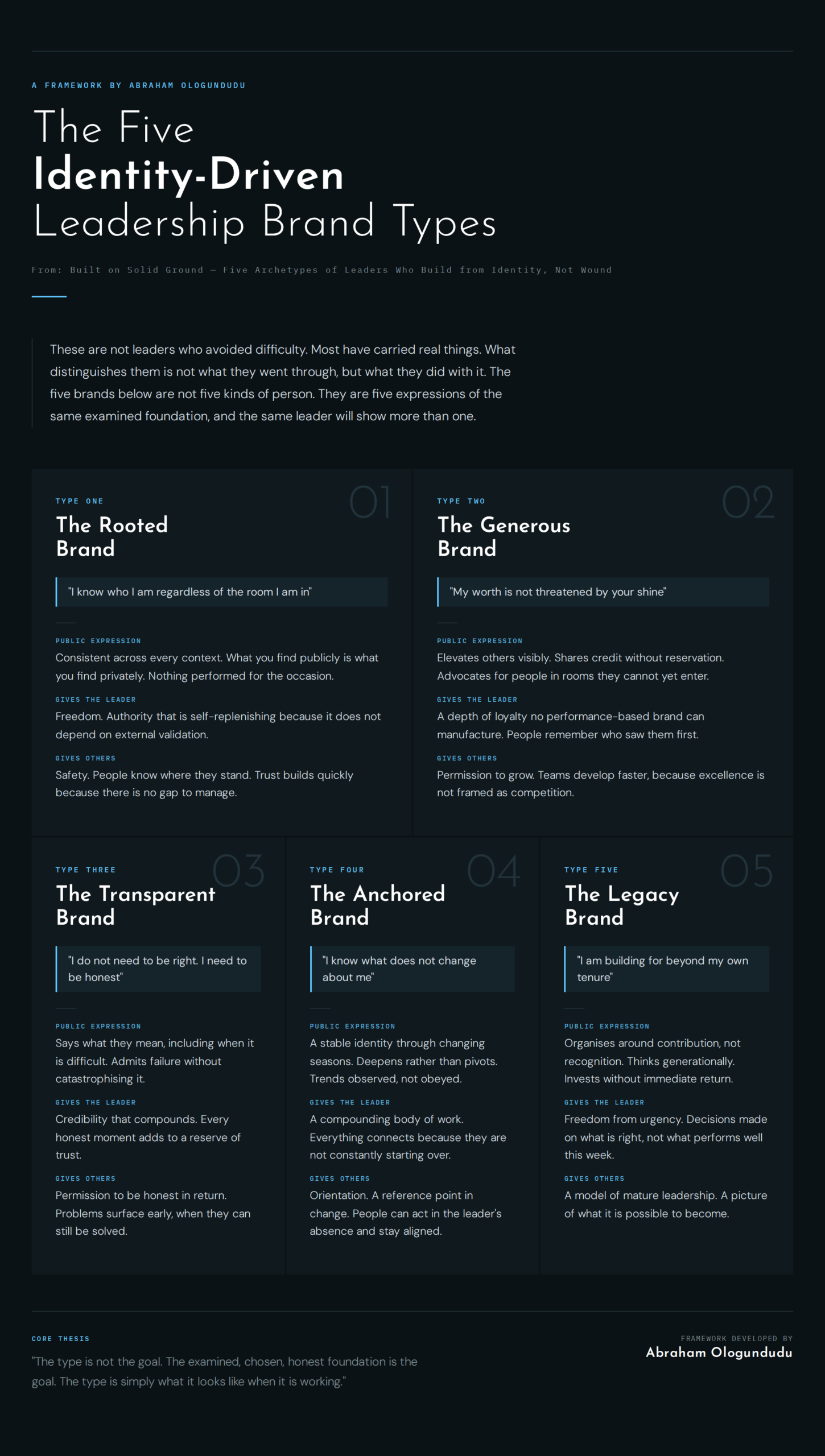
These archetypes are not ideals or aspirations. They are descriptions of real patterns observable in leaders who have done the foundational work. They are also not five separate kinds of person. They are five expressions of the same examined foundation, angles of light from a single source, and the same leader will throw more than one depending on where they are standing. As with the shame-driven types, most leaders will see traces of more than one. Which single type you are matters less than which foundation is operating beneath your brand.
1. The Rooted Brand
Foundation: I know who I am regardless of the room I am in
Public expression: Consistent across every context. The voice, the values, the positions do not shift based on audience. What you encounter publicly is what you find privately. Nothing is performed for the occasion.
What it gives the leader: Freedom. A Rooted leader is not spending energy maintaining a persona. Their authority is self-replenishing because it is not dependent on external validation. They can absorb criticism without being destabilised by it, because the criticism is not threatening the foundation.
What it gives others: Safety. People around a Rooted leader know where they stand. Trust is built quickly and compounds over time, because there is no gap between who the leader appears to be and who they actually are. Organisations built around Rooted leaders tend to develop cultures of honesty, because the leader has modelled it at every level.
Direct contrast to: The Chameleon Brand.
2. The Generous Brand
Foundation: My worth is not threatened by your shine
Public expression: Elevates others visibly. Shares credit without reservation. Advocates for people in rooms those people cannot yet enter. The generosity is not strategic. It is the natural expression of a leader whose own sense of worth is secure enough that another person’s success registers as good news.
What it gives the leader: A depth of loyalty that no performance-based brand can manufacture. People remember who saw them before they were visible. The Generous leader builds a network of genuine advocates over time, because the generosity was real and people remember it.
What it gives others: Permission to grow. Teams around Generous leaders tend to develop faster and more fully, because the leader’s security creates space for others to be excellent without it becoming a competition. The culture becomes one of collective advancement rather than individual positioning.
Direct contrast to: The Performer Brand.
3. The Transparent Brand
Foundation: I do not need to be right. I need to be honest
Public expression: Communicates with a precision that comes from having examined their own blind spots. Says what they mean, including when it is difficult. Acknowledges uncertainty. Admits failure without catastrophising it. Not because they are fearless, but because they have examined their fear and chosen honesty as a more durable foundation than the appearance of certainty.
What it gives the leader: Credibility that compounds. Every honest moment adds to a reserve of trust that performs far better over time than any polished image. The Transparent leader becomes someone people turn to because they will tell the truth about what they do not know, answer or not.
What it gives others: The permission to be honest in return. Cultures of transparency almost always trace back to a leader who modelled it first. When the leader says their uncertainty out loud, others learn it is safe to admit their own. Problems surface early, when they can still be solved, rather than late, when they cannot.
Direct contrast to: The Fortress Brand.
4. The Anchored Brand
Foundation: I know what does not change about me
Public expression: A stable public identity through changing seasons and contexts. Does not reinvent every eighteen months. Their content, voice, and positioning deepen rather than pivot, because they have identified what is permanent about who they are and what they are building toward. Trends are observed but do not determine direction.
What it gives the leader: A compounding body of work. Because they are not constantly starting over, everything they build connects to everything else. Over time this creates an intellectual and professional authority that is genuinely hard to replicate, because it has been accumulated deliberately and consistently over years.
What it gives others: Orientation. In environments of constant change, an Anchored leader is a reference point. People know what the leader stands for and can make decisions in their absence that align with it. The culture becomes self-directing in a way that distributed, chameleon leadership never achieves.
Direct contrast to: The Overclaimer Brand.
5. The Legacy Brand
Foundation: I am building for beyond my own tenure
Public expression: Organises their brand around contribution rather than recognition. Thinks generationally. Invests in people who will not immediately return the investment. Documents what they know because they genuinely want it to outlive their access to a stage. Shows up fully, not to be seen, but because their presence is part of the contribution.
What it gives the leader: A freedom from urgency that most visible leaders never experience. Because they are not chasing immediate recognition, they can make decisions based on what is right rather than what performs well this week. The work becomes lighter over time, not heavier, because it is not carrying the weight of a need to be affirmed.
What it gives others: A model of what leadership at its most mature looks like. Younger leaders who encounter a Legacy Brand leader are given a picture of what it is possible to become. Not a picture of success in the conventional sense, but a picture of a leader whose influence outlasts them, because it was never about being present to begin with.
Direct contrast to: The Ghost Brand.
What Identity-Driven Brands Build Over Time
The individual qualities of each archetype matter. But what matters more is what happens when they compound.
A leader who builds from examined identity does not just produce a better personal brand. They produce a different kind of organisation. The culture around them tends to reflect the same qualities that characterise their interior life: honesty, because the leader modelled it; patience, because the leader was not driven by urgency; depth, because the leader valued it over performance. What is true inside a leader tends to show up in what they build around them, and this holds for health as much as for wound.
The research on psychological safety is consistent. Amy Edmondson’s work at Harvard, among the most rigorous, shows that teams function best when members can speak candidly, admit mistakes, and acknowledge uncertainty. In practice, that climate tends to begin at the top: leaders who can hold their own not-knowing with equanimity make it safer for others to do the same. Leaders who cannot create the opposite, regardless of what values are written on the wall.
What identity-driven leaders build is a culture that functions at the level of its actual values rather than its stated ones. The personal brand is the surface of that. This is rarer than it sounds. And it is only possible when the leader’s public expression is an honest extension of a genuine interior, not a construction placed over one.
The Foundation Is the Work
Neither this article nor its companion is ultimately about branding. They are about what precedes branding, and what determines whether what gets built will hold. Together they form a two-part map: one direction traced by the unseen forces that shape how you lead, the other by the identity a leader consciously builds from.
The five shame-driven types and the five identity-driven types are directions, not fixed destinations. Each of us is moving in one direction or the other at any given time, and the direction can change. What determines it is not talent, circumstance, or even effort in the conventional sense. It is the quality of self-examination a leader is willing to undertake before they begin building in public.
That examination does not happen automatically. It requires a particular kind of environment, a particular quality of honest questioning, and often a guide who is not invested in maintaining the existing construction. It is slower than building. It is less immediately visible than building. And it is the only thing that makes the building worth doing.
The leaders described in this article are not extraordinary people. They are people who took an ordinary question seriously: who am I, actually, and is what I am building an honest expression of that?
The answer to that question is the foundation. Everything else is what you put on top of it.
The type is not the goal. The examined, chosen, honest foundation is the goal. The type is simply what it looks like when it is working.
Research & Further Reading
Marcia, J.E. (1966). Development and validation of ego identity status. Journal of Personality and Social Psychology, 3(5), 551-558.
George, B. & Sims, P. (2007). True North: Discover Your Authentic Leadership. Jossey-Bass.
Erikson, E.H. (1968). Identity: Youth and Crisis. Norton.
Edmondson, A. (1999). Psychological Safety and Learning Behavior in Work Teams. Administrative Science Quarterly, 44(2).
Goffman, E. (1959). The Presentation of Self in Everyday Life. Doubleday.
This article is the second in a two-part series on the psychology of leadership brands. The first part, The Psychology of Shame: The Hidden Force Shaping Your Leadership Brand, is available at abrahamologundudu.com.