

Estimated read time: 11 min read
Summary: Most leadership brands are not built on identity. They are built from unexamined wounds. This article explores the psychology of shame, how it operates invisibly beneath the surface of leadership behaviour, and how it quietly architects the public brands leaders construct. It introduces five recognisable shame-driven brand types, examines what each costs the leader and those they lead, and makes the case for a different starting point: building from origin rather than from wound.
There is a particular kind of leader most of us have encountered. Possibly in a boardroom. Possibly on a stage. Possibly, if we are willing to be honest, in our own mirror.
They have built something real. The visibility is there. The recognition is there. The titles, the influence, the narrative arc of a life that appears, from the outside, to be working. And yet something underneath does not feel solid. Not to them. The brand looks right. The room responds. But privately, quietly, there is a gap between what is being projected and what is actually true.
This is not a story about fraud or failures. It is a story about leaders who built before they knew what they were building from. The force doing the building, in most cases, is one we rarely name directly. It is a shame.
I know this not only from observing others. I have lived a version of it. For a long time, I told myself that my work would speak for itself. I don’t speak much about what others might call accomplishment, and I don’t want to build a life organised around what I have achieved. There is genuine conviction in that. But I have had to sit with a harder question: whether that posture began as a response before it became a conviction. Growing up, approval came when I met a high expectation. So somewhere along the way, I distanced myself from the very currency through which I had been measured. I stopped claiming, not only because I had decided visibility could corrupt, but because some part of me had decided that being seen was dangerous. The line between a principled boundary and a shame-shaped silence is thinner than most leaders want to admit. I have had to find that line in myself.
What if the way you show up publicly was never really a choice, but a response?
What Shame Actually Is
Before we apply this to leadership, we need to establish what shame actually is. It is one of the most misunderstood forces in human psychology, and that misunderstanding is precisely how it continues to operate undetected.
The distinction that matters is between shame and guilt. Guilt says, “I did something wrong.” Shame says, “I am something wrong.” Guilt is about an action. Shame is about identity. Guilt can motivate repair. It points to a behaviour and says, correct this. Shame does something far more corrosive. It points to the self and says, you are the problem.
Researchers like Brené Brown, June Price Tangney, and Donald Nathanson have spent decades studying shame across populations, contexts, and cultures. Their collective finding is consistent: shame is not weakness. It is not fragility. It is one of the most powerful and least examined forces shaping human behaviour. Ancient, adaptive, and extraordinarily intelligent. Which is precisely what makes it dangerous.
The insight that most leaders miss is this: shame does not disappear with success. It adapts. It finds new costumes. The shame that once drove a young person to prove themselves does not evaporate when the proof arrives. It upgrades into perfectionism, control, brand-building, or the relentless accumulation of credentials. Success does not resolve shame. It gives shame more sophisticated materials to work with.
Leadership, by its very nature, amplifies what is unresolved rather than resolving it. Authority does not heal old wounds. It gives them a platform.
How Shame Becomes a Brand
Every leader constructs a public self. This is not deception. It is the basic condition of operating in a world where you are seen. The sociologist Erving Goffman called this impression management: the conscious and unconscious ways we shape how we are perceived. The question is never whether a leader is managing an impression. The question is what the management is built on.
When shame is examined, named and understood and placed in its proper context, brand-building can be a genuine act of communication. The leader knows who they are. They are deciding how to express that truth in a way that is relevant, clear, and resonant. The brand is a signal.
When shame is unexamined, something very different happens. Brand-building stops being a communication strategy and becomes a coping strategy. The brand exists not to express identity but to protect against exposure. It is not a signal. It is a shield.
The difference between these two brands is not always visible from the outside. The Performer and the Authentic can look identical on a LinkedIn profile. Over time, though, the difference becomes legible to the people closest to them.
There are three recognisable signals that a leadership brand may be shame-driven. The first is credential overexplanation: a compulsive need to justify presence before anyone has questioned it. The second is audience inconsistency: a version of yourself in every room, with no stable core that persists regardless of who is watching. The third is disproportionate defensiveness when the brand is questioned, a reaction too strong for the situation, because what is being threatened is not merely a reputation but an entire architecture of self-protection.
Here is where the consequences extend well beyond the individual. When shame drives the brand, it eventually drives the organisation. Leaders who have not examined their interior wounds build systems and cultures that mirror those wounds. Silence cultures, where difficult truths cannot be spoken, often trace back to a leader who cannot tolerate being wrong. Fear-based accountability, where people comply but never commit, often originates in a leader whose own sense of worth is too fragile to permit genuine dissent. The suppression of innovation, the elevation of loyalty over competence, the creation of environments where performance is rewarded and personhood is not: these are not merely strategic failures. They are psychological ones. The brand that is visible externally is frequently a reflection of what the leader cannot face internally.
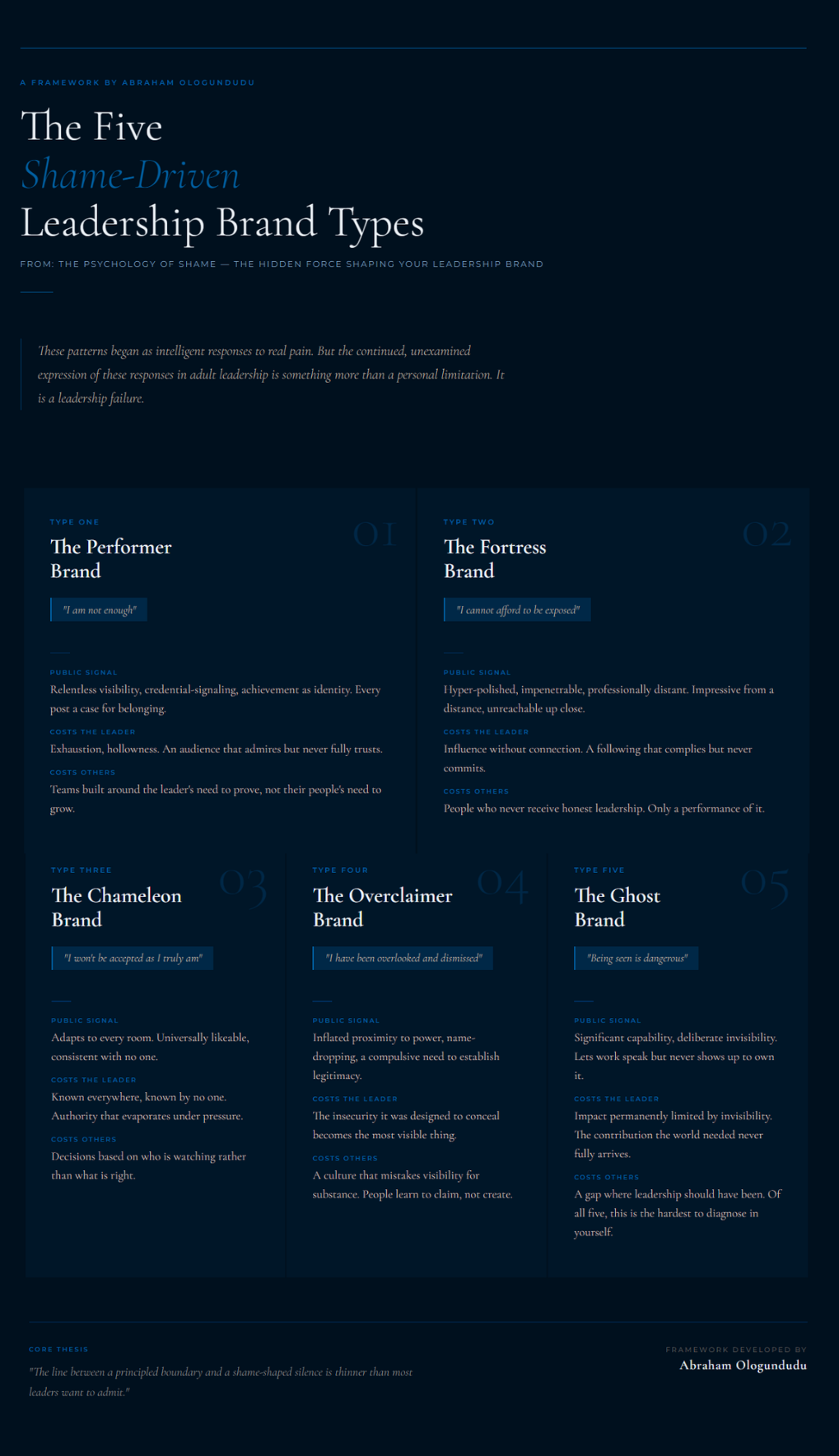
The Five Shame-Driven Leadership Brand Types
Shame researcher Donald Nathanson identified four primary directions people move when shame is triggered: withdrawal, avoidance, attack of self, and attack of others. Applied to the specific context of leadership and public brand construction, these directions produce five recognisable types.
Before exploring them, one thing needs to be said clearly. The origins of these patterns are not character flaws. A person who was made to feel inadequate, exposed, unacceptable, overlooked, or dangerous simply by being themselves did not choose that wound. That part is not a failure of character. It is the result of real experiences of real pain.
But the continued, unexamined expression of these responses in adult leadership, particularly in those with genuine influence over others, is something more than a personal limitation. It is a leadership failure. Not because the person is bad. Because leadership is responsibility. And leading from an unexamined wound causes real consequences for real people and real systems. What began as protection eventually becomes damage, and in most cases, the leader is the last to see it.
1. The Performer Brand
Root wound: I am not enough
Public signal: Relentless visibility, credential-signalling, achievement as identity. The brand is a curated record of proof. Every post a case for belonging. Every milestone announced before it has been fully processed.
What it costs the leader: Exhaustion, hollowness, and an audience that admires but never fully trusts. The Performer is always working, because stopping feels like exposure.
What it costs others: Teams built around the leader’s need to prove rather than their people’s need to grow. The culture becomes one of performance, where being seen to achieve matters more than actually building something.
2. The Fortress Brand
Root wound: I cannot afford to be exposed
Public signal: Hyper-polished, impenetrable, professionally distant. Impressive from a distance, unreachable up close. Every communication is managed. Every image is controlled. Nothing unfinished is ever shared.
What it costs the leader: Influence without connection. A following that complies but never commits. The Fortress rises but leads alone.
What it costs others: People who never receive honest leadership, only a performance of it. Teams that learn not to bring their real questions, because the real questions are never welcome.
3. The Chameleon Brand
Root wound: I won’t be accepted as I truly am
Public signal: Adapts to every room, mirrors every audience, universally likeable and consistent with no one. The content changes shape. The positions soften or sharpen depending on the crowd.
What it costs the leader: Known everywhere, known by no one. Authority that evaporates under pressure, because there is no stable core beneath the presentation.
What it costs others: Decisions made based on who is watching rather than what is right. A culture where adaptability is confused for integrity, until a moment of genuine pressure reveals there was no foundation.
4. The Overclaimer Brand
Root wound: I have been overlooked and dismissed
Public signal: Inflated proximity to power, exaggerated influence, heavy name-dropping, and a compulsive need to establish legitimacy before it has been questioned.
What it costs the leader: The insecurity it was designed to conceal becomes the most visible thing about the leader. The overclaiming announces the wound.
What it costs others: A culture that mistakes visibility for substance. People learn to claim rather than to create, because the leader has modelled that proximity to significance matters more than the generation of it.
5. The Ghost Brand
Root wound: Being seen is dangerous
Public signal: Significant capability, deliberate invisibility. Lets the work speak, but never shows up to own it. Declines platforms, deflects credit, and maintains a public presence so minimal that the leader is effectively unknown.
What it costs the leader: Impact permanently limited by invisibility. A contribution the world needed never fully arrives, not because the capacity was absent, but because the leader could not bear to be seen holding it.
What it costs others: The absence of a voice that could have changed something. Organisations left without direction. Younger leaders without a model. A gap where leadership should have been.
Of all five types, this one is the hardest to diagnose in yourself. It can look, from the inside, entirely like principle.”
The Moment of Recognition
Most leaders reading this will recognise something. In themselves. In someone they follow. In a version of themselves from a few years ago, they would rather not revisit.
That recognition is not comfortable. But discomfort that produces clarity is not the enemy of good leadership. It is frequently how it begins.
The more important question is not which type you are. Most leaders carry traces of more than one, and the dominant type shifts with context and pressure. What matters is whether you have ever genuinely examined what you are building from, and whether the foundation is actually yours, or whether it was laid for you by experiences you never agreed to have.
There is a particular kind of stillness required to answer that question honestly. It is the kind most leadership environments never make room for. Which is, in part, why so many brands built by capable people are built on ground that was never properly examined.
The danger is not recognising yourself in one of these types. The danger is not recognising yourself at all.
Building from Origin
The problem was never that these leaders lacked branding skill, positioning intelligence, or visibility strategy. The leadership landscape is full of people who understand the mechanics of presence, who know the right posting cadences, the right language, the right platforms. Most of them are still building on unstable ground.
The problem is that they began building before they knew who they were. They learned the craft of brand construction before they had done the harder, slower work of identity excavation. And so what got built, however polished, however strategically sound, was built on an unexamined foundation. Foundations like that do not fail immediately. They fail at the worst possible moment.
Real brand identity does not begin with messaging. It does not begin with positioning, a content strategy or a visual system. It begins with truth: honest, excavated, undefended truth about who you are, what you actually believe, what you are genuinely trying to build, and for whom.
There is a kind of foundational work, before design and before strategy, that most leaders skip. Not because they are lazy, but because the pressure to produce something visible is immediate and relentless. Slowing down feels indulgent. The questions this work requires are uncomfortable in a way that is harder to sit with than busyness.
The questions themselves are not complex. Who am I when the performance stops? What do I actually believe, not what I have said I believe, but what do my decisions reveal? What am I building, and is it genuinely mine, or is it a response to something I have never named?
When those questions are answered through genuine excavation rather than surface-level reflection, what gets built afterwards is different in kind, not just in quality. The clarity that comes from this work is not the clarity of having found the right words. It is the clarity of having found solid ground. A stable sense of self that does not shift when the room changes, when the audience is critical, when the season is difficult. A brand that is not assembled but revealed, because there was finally something real to reveal.
This foundational phase, the genesis of a leadership brand, is what separates leaders who have a brand from leaders who are one. One is constructed. The other is inhabited. One requires constant maintenance because it was never fully true. The other deepens over time because it was built on something that does not change.
Leaders who do this work describe the same experience regardless of their industry or stage. Not a feeling of having solved something, but of having stopped performing something. A steadiness that is not rigidity. A consistency that requires no effort to maintain because it is simply who they are, clarified, ordered, and directed.
What Are You Actually Building From?
Every leadership brand is built on something. The question is whether you chose the foundation, or whether something else chose it for you.
Shame is not passive. It is one of the most active forces in human experience: adaptive, intelligent, and entirely capable of constructing an entire public identity without the leader ever knowing it was the architect. The five types in this article are not edge cases. They are the majority of what passes for personal branding in leadership today. Not because leaders are dishonest people, but because most leadership development never reaches the level where this question is even asked.
You can build an impressive structure on an unstable foundation. It has been done. Some of the most visible leadership brands in the world are precisely that: impressive structures on ground that was never properly examined. They reveal themselves over time. In the moments that matter most, decisions under pressure, relationships that require genuine presence, a crisis that cannot be managed from behind a carefully curated image, the foundation becomes visible.
The leaders who will shape what comes next are not necessarily the loudest or the most visible. They will be the ones who were willing to stop, sit with the harder question, and build from an answer that was genuinely theirs.
Not from a broken wall. From a restored foundation.
What are you actually building from?
Research & Further Reading
Brown, B. (2012). Daring Greatly. Penguin.
Nathanson, D. (1992). Shame and Pride: Affect, Sex, and the Birth of the Self. Norton.
Tangney, J.P. & Dearing, R.L. (2002). Shame and Guilt. Guilford Press.
Goffman, E. (1959). The Presentation of Self in Everyday Life. Doubleday.
Aaker, J. (1997). Dimensions of Brand Personality. Journal of Marketing Research, 34(3).

Comment
Ruth Oladoja
I found this piece at the right time. Thank you for sharing it. God bless you Sir